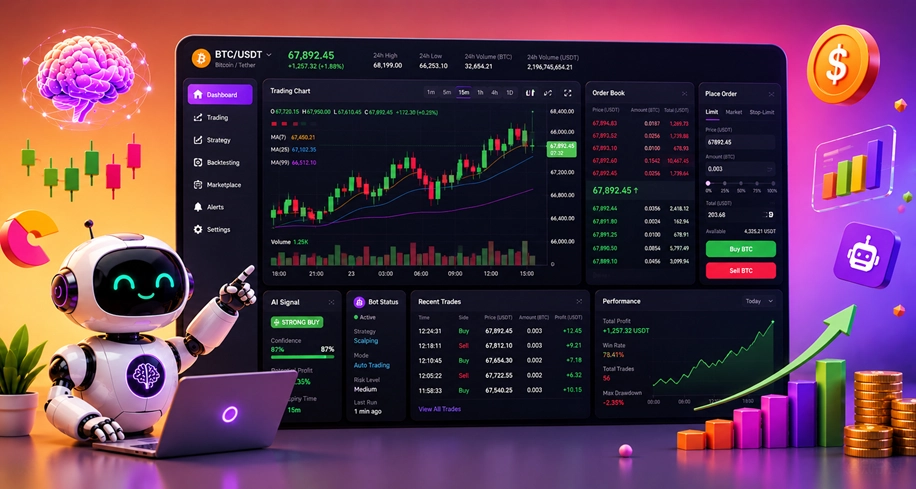
The way cryptocurrency trading works has changed dramatically in recent years. What was once driven by manual chart analysis and human decision-making is now increasingly powered by intelligent systems that can process data, identify patterns, and execute trades in real time.
An AI crypto trading platform represents this shift toward automation and intelligence. Instead of relying on human reaction speed, these systems use real-time market data, technical indicators, and algorithmic models to make faster and more consistent trading decisions.
This evolution is not just a trend—it reflects a broader industry movement. Today, over 70% of trading activity in global financial markets is driven by algorithmic systems, showing how automation has become essential for staying competitive in fast-moving environments like crypto.
As markets become more volatile and data-driven, traders and businesses are increasingly turning to automated crypto trading systems to gain an edge.
What Is an AI Crypto Trading Platform?
An AI crypto trading platform is an automated system that uses real-time market data, technical indicators, and artificial intelligence to analyze market conditions, generate trading signals, and execute trades with minimal human intervention.
It works by combining:
- Real-time data processing
- Indicator-based analysis
- AI-driven decision-making
- Automated trade execution
This allows traders and businesses to make faster, more accurate, and data-driven trading decisions in highly volatile crypto markets.
What Makes AI Crypto Trading Platforms Different?
What Makes AI Crypto Trading Platforms Different?
Beyond Traditional Bots: From Rules to Intelligence
Most trading bots follow predefined rules:
“If RSI is below X, buy. If MACD crosses, sell.”
An AI crypto trading platform goes beyond that.
It operates as a real-time decision system, where every signal is validated, interpreted, and filtered through multiple layers before execution.
Instead of a single logic block, the system works as a continuous event-driven pipeline:
- Market data streams in real time
- Indicators update instantly
- AI evaluates market context
- Strategy engine validates conditions
- Risk system controls exposure
- Execution engine places trades
This creates a tightly synchronized loop where every decision reflects the current market state, not outdated signals.
Why Timing Matters in Crypto Markets
Why Timing Matters in Crypto Markets
This architecture becomes especially important in short-term frame trading, such as:
- 1-minute charts
- 5-minute charts
- 15-minute charts
In these environments, even a few seconds of delay can:
- turn winning trades into losses
- generate false signals
- or cause missed entries entirely
That’s why modern systems are built around real-time synchronization rather than periodic updates.
Custom AI Trading Bot Solutions
Explore our AI Trading Bot Development Services to build custom automated trading solutions.
System Overview: A Synchronized Trading Intelligence Engine
System Overview: A Synchronized Trading Intelligence Engine
An AI crypto trading system is built as a modular, event-driven architecture designed for speed, accuracy, and scalability.
Key Components of the Trading System
The platform is designed to support both fully automated trading and human-in-the-loop execution, making it flexible for different user types—from individual traders to institutional platforms.
Instead of relying on a single decision layer, the system is built around three tightly coupled components:
- A market-aware indicator engine that continuously tracks technical signals
- An AI intelligence layer that interprets those signals in context
- A strategy engine that enforces structured decision-making
In the initial phase, the system is intentionally focused on BTC/USDT, which allows for deeper optimization. Bitcoin’s liquidity, volatility patterns, and institutional activity make it ideal for training both indicator-based strategies and AI models.
Additionally, the system integrates with major exchanges like Binance, Bybit, and BingX, ensuring access to deep liquidity and reliable execution infrastructure.
This architecture prioritizes precision over scale, which is critical when building a high-frequency, scalping-oriented trading system.
Why This Architecture Matters in AI Crypto Trading Systems
Why This Architecture Matters in AI Crypto Trading Systems
Most crypto trading bots fail not because of weak indicators or poor strategies, but because of structural limitations in their architecture. Traditional systems often rely on sequential processing, static signals, or single-layer decision-making, which creates delays, false signals, and poor adaptability in fast-moving markets.
In contrast, a modern AI crypto trading platform architecture is designed as a real-time, event-driven pipeline where each layer operates independently but synchronizes continuously with the rest of the system.
This shift in design is what enables speed, accuracy, and adaptability—the three factors that define success in algorithmic trading.
1. Eliminates Signal Lag through Continuous Processing
In traditional systems, indicators are calculated at fixed intervals, which introduces a delay between market movement and signal generation.
This architecture solves that by using:
- Continuous indicator computation
- Real-time WebSocket data streaming
- Instant propagation of updates across layers
As a result, trading decisions are always based on the latest possible market state, not outdated snapshots.
2. Reduces False Signals through Multi-Layer Validation
Single-layer trading bots often execute trades based on isolated conditions, such as RSI or moving average crossovers.
This system avoids that by introducing multiple validation layers:
- Indicator confirmation layer
- AI-based signal quality assessment
- Strategy rule validation
- Risk management filtering
This confluence-based decision model significantly reduces false positives and improves trade reliability.
3. Introduces Context-Aware Decision Making
Technical indicators alone cannot interpret market context—they only describe price behavior.
The AI layer adds contextual intelligence by evaluating:
- Market conditions surrounding the signal
- Historical performance of similar setups
- Probability of continuation vs reversal
This transforms the system from a rule-based bot into a probabilistic decision engine.
4. Ensures Capital Protection through Hard Risk Constraints
Many automated trading systems fail because they prioritize signal generation over risk control.
This architecture solves that by enforcing a dedicated risk management layer that operates as a hard override system.
Even if a trade is valid, it will not execute unless it satisfies:
- Position sizing rules
- Exposure limits
- Drawdown thresholds
- Volatility constraints
This ensures long-term system stability even in unpredictable market conditions.
5. Enables Real-Time Adaptation in Volatile Markets
Crypto markets are highly dynamic, and static systems quickly become ineffective.
This architecture is designed to adapt in real time by continuously:
- Re-evaluating market conditions
- Updating indicators instantly
- Adjusting trade management strategies
- Feeding outcomes back into the system
This creates a self-adjusting trading loop that evolves with market behavior.
6. Builds a Scalable Foundation for High-Frequency Trading
Because each module operates independently and communicates through event streams, the system is inherently scalable.
This allows:
- Parallel processing of market data
- Low-latency execution pipelines
- Multi-exchange integration
- Future expansion to multiple assets and strategies
This modular design is essential for building production-grade high-frequency trading systems.
Advanced Arbitrage Trading Strategies
For advanced strategies, see our guide on crypto flash loan arbitrage bot development.
Layered Architecture of the AI Crypto Trading System
Layered Architecture of the AI Crypto Trading System
Breaking Down the End-to-End Trading Pipeline
A modern AI crypto trading platform is not built as a single block of logic. Instead, it follows a layered architecture, where each component is responsible for a specific function in the trading lifecycle.
This design ensures that the system is:
- Faster in processing
- More accurate in decision-making
- Easier to scale and optimize
Each layer operates independently but remains continuously connected through real-time data flow. This allows the platform to function as an asynchronous pipeline, where data moves seamlessly from analysis to execution and back into feedback.
At a high level, the system can be divided into eight key layers:
- Real-Time Market Data Layer
- Indicator Engine
- AI Integration Module
- Strategy Engine
- Risk Management Layer
- Trade Execution Layer
- Trade Monitoring & Lifecycle Management
- Logging, Feedback, and Optimization
Together, these layers form a closed-loop intelligent trading system that continuously learns, adapts, and improves.
Layer 1: Real-Time Market Data Layer
The Foundation of Every Trading Decision
Every trading decision begins with data—and in crypto markets, the quality and speed of that data directly determine performance.
The Market Data Module is responsible for continuously collecting and streaming both real-time and historical data from connected exchanges. Unlike traditional polling systems, this platform uses WebSocket connections, which allow it to receive live market updates instantly as they occur.
This includes:
- Candlestick data (OHLCV) across multiple timeframes
- Tick-level price updates
- Volume fluctuations and micro-movements
Because the system operates on short timeframes, even a delay of a few seconds can make indicators unreliable. That’s why this module is designed to maintain low-latency, high-frequency data streams, ensuring that every downstream component works with the most current market state.
At the same time, historical data is continuously maintained and updated. This is crucial not just for indicator calculations, but also for AI models that rely on pattern recognition and trend analysis over time.
Layer 2: Indicator Engine
Continuous Computation, Not Static Calculation
Once market data enters the system, it is immediately processed by the Indicator Module, which acts as the mathematical backbone of the trading logic.
Unlike basic trading systems that calculate indicators only when needed, this module operates continuously. It maintains rolling calculations for each indicator, updating values in real time as new market data arrives.
This distinction is critical.
Because in fast-moving markets, indicators like RSI or MACD can shift rapidly within seconds. A delayed or recalculated value can result in missed entries or false signals.
The system solves this by ensuring that:
The module continuously updates indicator values and provides them to the strategy engine and AI module in real time.
This creates a constant stream of fresh signals, allowing both the AI and the strategy engine to react instantly.
The indicators themselves are not used in isolation. Instead, they are treated as dynamic inputs, forming a real-time snapshot of market conditions, including:
- Momentum strength
- Trend direction
- Overbought/oversold conditions
- Volatility shifts
By maintaining continuous computation, the platform avoids one of the most common flaws in trading systems – lagging indicator dependency.
Layer 3: AI Integration Module
Adding Context to Raw Trading Signals
Technical indicators alone cannot fully explain market behavior. They show what is happening, but not always why.
This is where the AI Module becomes essential.
The AI layer takes structured inputs—such as indicator values, recent price action, and historical patterns – and transforms them into context-aware insights.
Instead of blindly following indicator triggers, the AI evaluates:
- Whether a signal is strong or weak
- Whether current conditions support the signal
- Whether similar patterns historically led to profit or loss
By integrating models such as OpenAI (ChatGPT) or Anthropic (Claude), the system introduces a reasoning layer that traditional bots lack.
The output is not just a signal, but a qualified decision, including:
- Trade recommendation (BUY / SELL / HOLD)
- Confidence level (probability-based scoring)
- Contextual reasoning (market interpretation)
For example, two identical RSI signals may produce different outcomes depending on market conditions. The AI helps differentiate these scenarios, reducing false positives and improving trade accuracy.
Layer 4: Strategy Engine
Structured Decision-Making under Defined Rules
The Strategy Engine acts as the system’s decision authority. It does not generate signals on its own—instead, it validates and filters inputs from both the indicator module and the AI layer.
This separation is intentional.
By isolating decision logic, the system ensures that trades are executed only when multiple layers of confirmation align.
For instance, a trade may only be triggered if:
- RSI indicates oversold conditions
- MACD confirms a bullish crossover
- AI confidence exceeds a defined threshold
This multi-condition validation significantly reduces noise, which is a major challenge in short timeframe trading.
The strategy engine essentially converts raw signals into actionable decisions, ensuring that every trade is backed by both mathematical logic and contextual intelligence.
Layer 5: Risk Management Layer
The System’s Safety Net for Capital Protection
No trading system is complete without robust risk control. In fact, risk management often determines long-term success more than strategy accuracy.
Before any trade is executed, it passes through a dedicated risk management layer.
This layer evaluates whether the trade aligns with predefined safety parameters, such as:
- Maximum allowable loss per trade
- Total exposure limits
- Drawdown thresholds
- Position sizing rules
This ensures that even if a signal is valid, it will not be executed if it violates risk constraints.
In volatile markets like crypto, where sudden price swings are common, this layer acts as a critical safeguard against catastrophic losses.
Layer 6: Trade Execution Layer
Where Speed Meets Precision in Real Markets
Once a trade passes all validation checks, it moves to the execution phase.
The system supports two operational modes:
- Semi-automated, where trades require manual approval
- Fully automated, where trades are executed instantly
Execution is handled through exchange APIs, ensuring that orders are placed directly in the user’s account.
Speed is a key factor here. In scalping strategies, even minor delays can impact profitability. That’s why the system is optimized for:
- Low-latency order placement
- Accurate pricing
- Reliable API handling
Layer 7: Trade Monitoring & Lifecycle Management
Managing Trades beyond Entry and Exit
Execution is not the end—it’s just the beginning of the trade lifecycle.
Once a position is opened, the system continues to monitor it in real time. It dynamically adjusts based on market conditions, ensuring that the trade is managed intelligently until closure.
This includes:
- Updating stop-loss levels
- Triggering take-profit conditions
- Applying trailing strategies
Because the same data → indicator → AI pipeline continues running, the system can re-evaluate open trades continuously, rather than relying on static exit conditions.
Layer 8: Logging, Feedback, and Continuous Improvement
Closing the Loop in an Intelligent Trading System
Every action within the system is recorded in detail. This includes:
- Entry and exit decisions
- Indicator states at the time of trade
- AI reasoning and confidence levels
- Profit and loss outcomes
This data is not just stored—it is actively used to improve the system.
Over time, it enables:
- Strategy refinement
- AI model improvement
- Performance optimization
This creates a feedback loop, where the system becomes smarter and more efficient with continued use.
AI Trading Revolution in 2026
Explore how AI-driven systems are transforming crypto trading strategies and predictive analytics in 2026.
Final Insight: Why This Architecture Wins
Final Insight: Why This Architecture Wins
The strength of this system lies in its continuous, real-time synchronization.
Instead of operating in isolated steps, every component works together in a seamless loop:
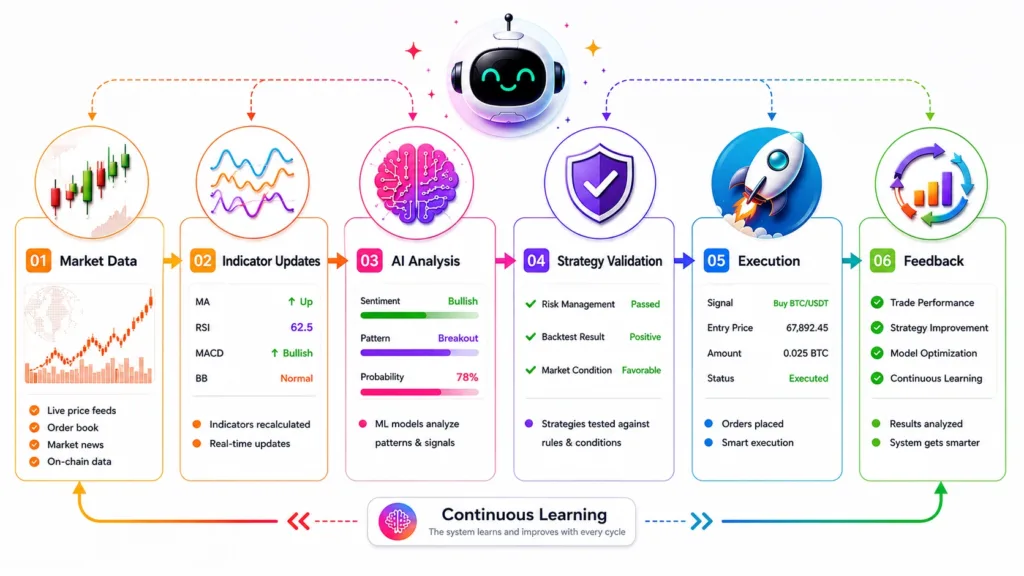
This architecture ensures that the platform is always:
- Up-to-date with market conditions
- Adaptive to changing trends
- Optimized for high-frequency decision making
In today’s algorithm-driven crypto markets, this level of integration is no longer optional—it is essential.
Build Your AI Crypto Trading Platform
Build Your AI Crypto Trading Platform with KIR Chain Labs
Building a high-performance AI crypto trading platform requires more than strategy—it demands the right architecture, real-time infrastructure, and deep technical expertise.
At KIR Chain Labs, we help startups and enterprises design and develop scalable, intelligent, and production-ready trading systems tailored to real-world market conditions.
Whether you’re launching a new trading product or upgrading an existing system, our team delivers:
- End-to-end AI trading platform development
- Custom strategy and architecture design
- Secure multi-exchange integration
- Scalable, low-latency infrastructure
Start Building Your AI Trading Platform Today
Frequently Asked Questions
Frequently Asked Questions
1. What is an AI crypto trading platform?
An AI crypto trading platform is an automated system that uses real-time market data, technical indicators, and artificial intelligence to analyze market conditions, generate trading signals, and execute trades without manual intervention. It improves speed, accuracy, and decision-making in volatile crypto markets.
2. How does an AI crypto trading platform work?
An AI crypto trading platform works through a multi-layered process that includes real-time data collection, indicator analysis, AI-based signal evaluation, strategy validation, risk management, and automated trade execution via exchange APIs. The system continuously monitors and optimizes trades using feedback loops.
3. What is the difference between a trading bot and an AI trading platform?
A traditional trading bot follows fixed rules based on predefined indicators, while an AI crypto trading platform uses machine learning and contextual analysis to adapt to changing market conditions. AI platforms provide smarter, probability-based decisions instead of static rule execution.
4. Are AI crypto trading platforms profitable?
AI crypto trading platforms can improve trading accuracy and efficiency, but profitability depends on strategy quality, risk management, and market conditions. AI enhances decision-making, but it does not guarantee profits without proper system design and optimization.
5. Which exchanges can an AI trading platform integrate with?
Most AI crypto trading platforms support integration with major exchanges such as Binance, Bybit, and BingX using secure API connections. This allows real-time data access and automated trade execution across multiple trading environments.
6. Is AI crypto trading suitable for startups and businesses?
Yes, AI crypto trading platforms are widely used by startups and enterprises to build scalable trading products, SaaS platforms, and automated investment systems. With the right architecture, they can support multi-user environments, high-frequency trading, and cross-exchange operations.