Prediction markets are becoming an effective way to turn collective intelligence into real-time insights about future events. From politics to sports, these platforms allow participants to express their views through tradable outcome-based contracts. Industry estimates have also projected that total prediction market volume could grow from approximately $51 billion in 2025 to $1 trillion by 2030.
This rapid growth has put platforms like Polymarket and Kalshi into the spotlight, encouraging businesses and entrepreneurs to explore this emerging digital economy. The integration of blockchain, smart contracts, artificial intelligence, real-time data, and digital wallets is further expanding the possibilities for building innovative prediction ecosystems.
As interest in event-based forecasting continues to rise, a prediction marketplace is becoming an attractive option for businesses to enter this evolving market. But what does it take to build a successful prediction marketplace platform? Let’s explore.
What is a Prediction Marketplace Platform?
A prediction marketplace is an online platform where people share their views on future events by participating in outcome-based markets. Users can explore different topics, choose the outcomes they believe are likely to happen, and trade their positions as new information changes market expectations.
Unlike traditional betting, where users typically risk against fixed odds set by an operator, prediction markets reflect the collective expectations of participants through changing market prices. This model is gaining attention across areas such as politics, sports, finance, technology, and entertainment. Launching a prediction marketplace offers a way to build interactive communities, encourage user participation, explore diverse revenue models, and create a platform around real-time forecasting and public sentiment.
Why Now Is the Perfect Time to Launch?
Why Now Is the Perfect Time to Launch?
Prediction markets are developing into a fascinating area for creating interactive, forward-thinking projects. The opportunity isn’t limited to one region either; you can build platforms that attract a global audience with diverse interests. Considering all the factors, 2026 could be the right time to explore prediction marketplace development.
Growing Market Interest
Capitalize on the surging global demand for real-world event forecasting and decentralized intelligence.
Rising Platform Adoption
Driven by seamless onboarding, intuitive UI, and a rapidly expanding active user base seeking market-driven insights.
Web3 & Fintech Growth
A future-ready solution that streamlines settlements with enhanced security, operational transparency, and intelligent automation.
Global Reach
Unlock borderless, permissionless participation across diverse markets, cultures, and event categories.
Multiple Revenue Streams
Generate sustainable income through transaction fees, liquidity provision, premium data feeds, and API access.
Early Mover Advantage
Capture your market share and build strong network effects ahead of mainstream institutional adoption
How AI Is Transforming Prediction Marketplaces
How AI is Transforming Prediction Marketplaces
AI is bringing a smarter and more interactive layer to prediction marketplaces. Instead of making users go through endless amounts of information on their own, AI can help them understand what is happening around a particular event. It can evaluate market updates, news, public sentiment, and historical data to provide insightful information that enhances the overall experience. AI-powered recommendations can also help users to find markets that suit their interests and keep them informed when significant changes occur.
For platform owners, AI can offer value beyond user insights. It can help to track the latest trends, detect unusual activity, improve market performance, and support more personalized experiences. As prediction marketplaces are fast-evolving platforms, the blend of human opinions with AI-driven analysis could make these platforms more dynamic and informative. Rather than replacing user judgment, AI may complement it, making it easier for participants to explore information more efficiently while giving prediction marketplaces fresh ways to improve engagement and differentiate themselves in a crowded digital landscape.
The End-to-End Workflow of a Prediction Marketplace Platform
A prediction marketplace brings everything in a structured flow. From the moment a new market is introduced to the final distribution of rewards, each stage plays an important role in delivering a smooth and transparent experience. Here’s how our complete workflow typically unfolds:
1. Market Creation and Event Listing
The journey starts with creating a market around a specific event, question, or future outcome. The platform defines the available outcomes, participation period, and settlement rules before publishing it for users.
2. User Registration and Account Setup
Users sign up, complete any required verification, and configure their preferred payment or wallet options. They can then browse active markets and explore the information available for each event.
3. Market Analysis and Position Selection
Participants review the event, consider relevant information, and select the outcome they believe is most likely. Users can engage with the market by choosing positions that reflect their predictions.
4. Trading and Real-Time Market Activity
As participants enter and exit positions, market activity continues to mature. Prices can fluctuate based on demand, user sentiment, and new information, facilitating a dynamic environment around each event.
5. Event Outcome Verification
Once the event ends, the final result is fixed using data sources or predefined verification mechanisms. This ensures that the market outcome is determined according to established rules.
6. Market Settlement and Payout
The market is formally settled once the outcome has been confirmed. The prediction cycle ends when participants who chose the right result receive their eligible bonuses or awards.
Top Prediction Market Platforms
Top Prediction Market Platforms You Should Know
Launching a prediction market with a pre-coded script cuts through months of complex backend development and high upfront costs. By adopting battle-tested order books and intuitive design layouts from industry pioneers, you can instantly give your traders a smooth, dependable environment they already know how to use. Here are some of the high-demand prediction platforms:
- Polymarket
- Kalshi
- Manifold
- Augur
- PredictIt
How to Build a Prediction Marketplace Platform?
Building a prediction marketplace requires more than just adding features to a website. A successful platform needs a clear market concept, smooth user experience, reliable outcome verification, strong security, and a scalable architecture. Here’s a practical six-step development process:
1. Define the Market Concept and Business Model
Start by deciding what type of platform you want to create and who your target audience is. Choose the market categories, participation model, revenue streams, and geographical focus.
2. Plan the Features
Identify the essential capabilities users actually want. At the same time, plan a simple interface that makes it easy for users to navigate and understand available outcomes.
3. Choose the Right Technology and Architecture
Select the technology frameworks that support your platform’s requirements, including frontend and backend frameworks, databases, APIs, cloud infrastructure, and blockchain networks if required.
4. Develop the Core Prediction Marketplace
Build the platform’s core elements first, such as market formation, user involvement, trading or position management, wallet connectivity, and administrative controls. Development should focus on creating a smooth experience.
5. Security
Ensure security and reliability using identity verification, fraud prevention, encryption, secure payments, and verified data sources. Pre-launch testing and security audits are critical.
6. Launch, Monitor, and Scale the Platform
After deployment, track performance and gather feedback to fix issues. Continuously optimize, introducing AI insights, mobile apps, and new markets as adoption grows.
Centralized vs. Decentralized Prediction Marketplaces
Centralized vs. Decentralized Prediction Marketplaces
Both centralized and decentralized prediction marketplaces offer different advantages depending on the platform’s goals, target users, and operational model. Here’s a simple comparison of the key factors:
| Feature | Centralized Prediction Marketplace | Decentralized Prediction Marketplace |
|---|---|---|
| Platform Control | Managed and controlled by a central organization | Operations are distributed across a decentralized network |
| Transparency | Depends on the platform’s policies and reporting | Greater transparency through blockchain-based records |
| User Experience | Usually simpler and more familiar | May require users to understand blockchain interactions |
| Scalability | Can often scale efficiently with centralized infrastructure | Scalability depends on the underlying network |
| Blockchain Dependence | Blockchain may not be required | Blockchain is the part of the core system |
| Security | Relies on centralized security systems and platform controls | Uses blockchain, smart contracts, and decentralized infrastructure |
| Best Suited For | Platforms prioritizing simplicity, speed, and centralized control | Platforms prioritizing transparency, decentralization, and user ownership |
Core Features of Our Successful Prediction Marketplace
Core Features of Our Successful Prediction Marketplace Platform
A well-designed prediction marketplace should make it easy for users to discover events, evaluate possible outcomes, participate in markets, and track their positions. The right feature set can also improve engagement, trust, and long-term platform growth. Here are six core features to consider:
User Registration and Profile Management
Onboard seamlessly with secure logins, manage personal details, track trading history, set preferences, and easily handle identity verification, all from one clean, user-friendly hub.
Market Creation and Management
Set up custom markets effortlessly by defining questions, setting timelines, choosing data sources, and managing active trading rules with intuitive, flexible admin controls.
Real-Time Market Dashboard
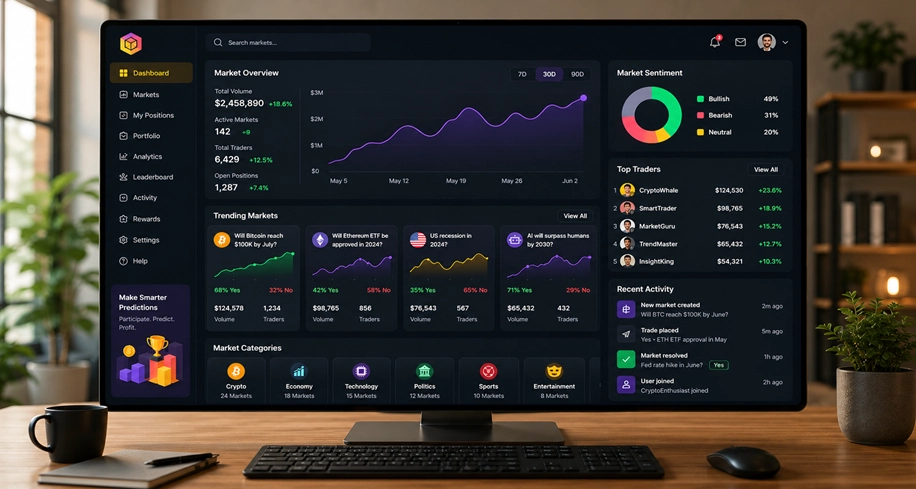
Track live price movements, monitor order books, view dynamic probabilities, and manage open positions instantly through a fast, interactive, and visually engaging control center.
Wallet & Payment Integration
Connect crypto wallets or traditional payment methods smoothly for fast, frictionless deposits, effortless trading, and secure, transparent withdrawals whenever you are ready.
Outcome Verification
Guarantee fair payouts through reliable, tamper-proof data feeds and smart contracts that automatically resolve markets and distribute funds the moment events conclude.
Admin Dashboard and Analytics
Monitor platform health, oversee user activity, track overall liquidity, manage risk, and gain actionable performance insights from a centralized, real-time command station.
Future Trends in Prediction Marketplace Development
The next generation of prediction marketplaces is likely to become more intelligent, connected, and accessible. AI-powered prediction markets can help users understand updates, analyze views, and discover useful insights, while advanced analytics can turn complex market data into information that is easier to understand.
Blockchain-based forecasting can bring greater transparency to market activity and outcome settlement, while multi-chain ecosystems may allow platforms to reach users across different blockchain networks. We can also expect more real-time event markets, where users can participate in markets as events unfold and new information becomes available.
At the same time, prediction marketplaces are moving toward more social and convenient experiences. Social prediction platforms can encourage users to share opinions, discuss events, and follow popular forecasters. Mobile-first experiences will make it easier to participate on the go, while automated market creation can help platforms introduce relevant markets faster based on trending events. Together, these developments could make prediction marketplaces more engaging, dynamic, and personalized, creating new possibilities for both platform owners and users.
Prediction Market Platforms: Comparison
Prediction Market Platforms: Feature Comparison
Every prediction marketplace can take a different approach depending on its target audience, market categories, and business model. Some prioritize simplicity and community participation, while others focus on advanced trading. Comparing these key areas can help identify the features and capabilities that can make a prediction marketplace more engaging, scalable, and competitive.
| Core Platform | Advanced Platform | Future-Ready Platform |
|---|---|---|
| User Registration | Real-time Market Analytics | AI-powered Market Insights |
| Market Creation & Management | Advanced Trading Functionality | AI-driven Trend & Sentiment Analysis |
| Event-based Prediction Markets | Multiple Payment Options | Predictive Analytics |
| Wallet Integration | Real-time Data Feeds | Automated Market Creation |
| Admin dashboard | Advanced User Dashboards | Intelligent Recommendations |
| Basic Market Settlement | Automated Outcome Resolution | Advanced Oracle Integration |
| Basic Analytics | Enhanced Security Controls | Multi-chain Functionality |
Why Choose KIR Chain Labs?
Why Choose KIR Chain Labs as Your Trusted Partner?
As a front-runner in blockchain and Web3 development, KIR Chain Labs focuses on creating flexible architectures that can adapt as platform requirements evolve. Our development approach prioritizes customization, security, scalability, and performance, helping create a strong foundation for long-term platform growth.
As a leading Prediction Marketplace Platform Development Company, KIR Chain Labs provides a comprehensive development approach that supports the evolving needs of marketplace platforms. The goal is to help create reliable, scalable, and future-ready solutions that can adapt to changing user expectations and emerging opportunities across the prediction market ecosystem.
Blockchain & Web3 Expertise
We combine both blockchain and Web3 knowledge to create prediction marketplaces built around modern decentralized technologies and evolving digital ecosystems.
Customized Development Approach
Every platform is shaped around your market concept, target audience, business model, and unique requirements instead of following a standard development template.
Advanced Technology Integration
KIR Chain Labs integrates relevant technologies, including smart contracts, wallets, AI capabilities, APIs, and real-time data solutions, based on project needs.
Security-Focused Solutions
From secure transactions to reliable platform architecture, we prioritize essential security measures to help protect users, data, and marketplace operations.
End-to-End Development Support
From initial planning to deployment, optimization, and ongoing maintenance, we support your platform throughout its growth journey.
Conclusion
Prediction marketplaces are opening a new avenue for users to engage with future events, share expectations, and participate in outcome-based markets. As interest continues to grow across sectors, the scope to build innovative platforms is becoming increasingly attractive.
From choosing the right business model and defining essential features to integrating AI capabilities and blockchain technology, every development decision can influence the platform’s long-term potential. A well-planned solution should focus on delivering a smooth user experience while remaining flexible enough to scale with changing market demands.
With the right technology partner, businesses can turn a prediction marketplace concept into a reliable and engaging digital ecosystem. As the prediction economy continues to evolve, investing in a thoughtfully designed platform can help create new opportunities for user engagement, innovation, and sustainable growth.
Frequently Asked Questions
Frequently Asked Questions
How much does it cost to build a prediction marketplace platform?
The cost depends on the platform’s features, technology, customization, blockchain integration, security requirements, and development complexity. A basic platform may cost less than an advanced solution with AI and multi-chain capabilities.
How long does it take to develop a prediction marketplace?
Development time depends on the project’s scope and complexity. A basic MVP can be developed faster, while a feature-rich platform with advanced integrations may require more time.
How do prediction marketplaces make money?
Common revenue models include transaction fees, trading fees, market listing charges, premium subscriptions, withdrawal fees, API access, advertising, and data or analytics services.
Can AI be integrated into a prediction marketplace?
Yes. AI can support market analysis, sentiment tracking, trend identification, personalized recommendations, automated insights, and advanced analytics to improve the overall user experience.
Can I Build a Blockchain-Based Prediction Marketplace?
Yes, you can build a blockchain-based prediction marketplace using smart contracts, decentralized infrastructure, crypto wallets, and oracle solutions for transparent transactions and automated outcome settlement.
How Are Prediction Market Outcomes Verified?
Prediction market outcomes are verified using trusted data sources, APIs, or blockchain oracles that provide accurate event results, enabling transparent and reliable market settlement