The way people collect and trade cards has changed.
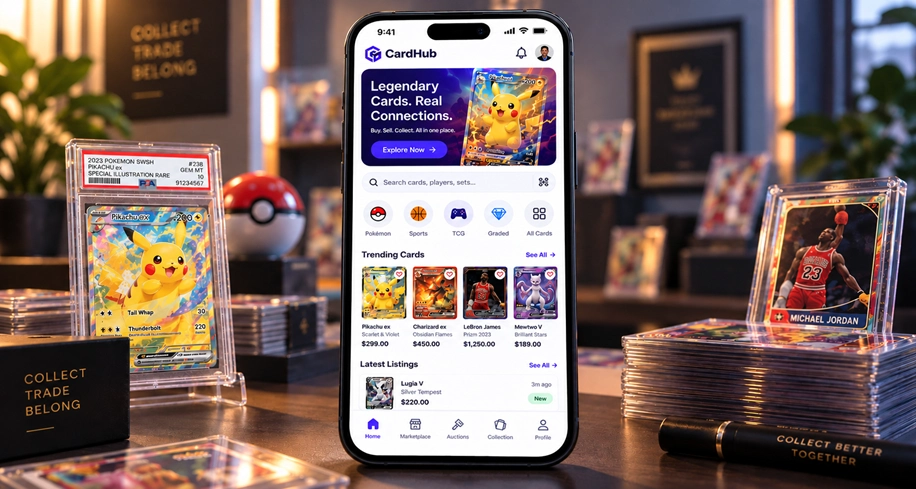
What once happened primarily through hobby shops, card shows, local communities, and collector forums is increasingly happening through digital marketplaces. A collector looking for a rare Pokémon card, a graded baseball card, or a specific sports trading card can now search thousands of listings, compare prices, communicate with sellers, place bids, and manage their collection without leaving an app.
This change has created a new business opportunity for entrepreneurs, card dealers, sports brands, TCG communities, and Web3 businesses: building a trading card marketplace app designed around a specific collecting experience.
But a trading card marketplace is not simply an e-commerce store with card images and a checkout button.
The value of the platform comes from bringing together buyers, sellers, card data, payments, authentication, discovery, and collection management in one ecosystem. Depending on the business model, it can go even further with auctions, live card breaks, digital pack opening, AI-powered card recognition, card vaults, and blockchain-based ownership.
So, what does it actually take to build one?
What Makes a Trading Card Marketplace Different From a Regular Marketplace?
At first glance, selling a trading card online looks similar to selling any other product.
A seller uploads an image, enters a price, and waits for a buyer.
The difference becomes obvious when the marketplace begins to scale.
Consider a collector searching for a specific card. They may not simply type “baseball card.” They could be looking for a particular player, year, set, parallel, card number, condition, grading company, and grade.
A TCG collector may search by game, expansion set, rarity, language, edition, foil status, and card number.
This means the marketplace needs to understand the structure of collectible cards.
The platform must make it easy for sellers to describe a card accurately and equally easy for buyers to find exactly what they want.
That is one of the first areas where trading card marketplace app development differs from conventional marketplace development. The product needs to be designed around how collectors actually think and search.
The Opportunity Behind a Trading Card Marketplace
The Opportunity Behind a Trading Card Marketplace
The trading card industry has developed into a substantial global collectibles market, creating opportunities for businesses that can offer more than a basic buying and selling platform.
The scale of the market is already significant. eBay reported more than 2.5 billion trading cards sold on its platform between 2021 and 2023, highlighting the enormous volume of online card transactions. eBay has also continued expanding its authentication services for high value trading cards, reflecting growing demand for trust and verification in the category.
The sports card segment is also attracting major consumer and investor interest. GemRate reported more than 26 million sports cards were graded in 2023, demonstrating the growing importance of professionally graded cards in the collectibles ecosystem.
These numbers indicate that the opportunity is not simply about creating another website where users can list cards.
1. Focus on a Specific Collector Segment
Established marketplaces already have large audiences and extensive inventories. Competing with them by offering every type of card may require significant investment in sellers, inventory, marketing, and customer acquisition.
A more focused approach can be to build a marketplace around a specific collector community, such as:
- Pokémon and other TCG collectors
- Sports card collectors
- High value graded cards
- Professional card dealers
- Regional collector communities
- Digital and physical collectibles
A specialized marketplace can provide tools and experiences that general marketplaces may not prioritize.
2. Build Around Collection Management
Collectors do not only buy cards. They research prices, maintain collections, create wishlists, monitor availability, compare editions, and track potential value changes.
A trading card marketplace app can combine these activities in one platform. For example, a collector could purchase a card and automatically add it to a digital collection while continuing to monitor its market price.
3. Create Reasons to Return
The strongest marketplace opportunity comes from creating value even when users are not making a purchase.
A platform could allow collectors to:
- Track their collection value
- Create card wishlists
- Receive new listing alerts
- Monitor price changes
- Compare card editions
- Buy and sell cards
- Participate in auctions
- Trade with other collectors
- Join live card breaks
- Manage graded card inventories
This creates a recurring user experience rather than a platform that is visited only when someone wants to purchase a card.
4. Make Trust a Core Feature
As card values increase, authentication, grading, seller reputation, secure payments, and transaction protection become increasingly important.
This is particularly relevant for graded and high value cards. A marketplace that integrates authentication workflows, grading information, seller verification, secure payment processing, and transaction tracking can address some of the biggest concerns buyers have when purchasing collectibles online.
5. Turn the Marketplace into an Ecosystem
The opportunity is therefore broader than building another online card store. A successful trading card marketplace app can combine commerce with collection management, price discovery, auctions, trading, live breaks, and community features.
The objective is to give collectors a reason to open the app regularly, whether they are buying a card, checking their collection, monitoring prices, looking for a specific item, or participating in the wider collecting community.
Key industry indicators
| Statistic | What it shows |
|---|---|
| 2.5+ billion trading cards sold on eBay between 2021 and 2023 | Demonstrates the scale of online card transactions |
| 26+ million sports cards graded in 2023, according to GemRate | Shows strong demand for grading and authentication |
| Growing adoption of online marketplaces | Creates opportunities for specialized digital collecting platforms |
These figures suggest that the opportunity is not necessarily to compete with established marketplaces on inventory alone. The stronger opportunity can be to build a specialized, trusted, and feature rich collecting platform around a clearly defined audience.
How Does a Trading Card Marketplace App Work?
How Does a Trading Card Marketplace App Work?
The basic journey is straightforward.
Seller Creates an Account
The seller registers on the platform and creates a profile with relevant account and payment details.
Seller Lists the Card
The seller adds a card by uploading images and providing details such as card name, edition, condition, grading, price, and shipping information.
Buyer Searches for Cards
Buyers browse the marketplace using keywords, categories, filters, price ranges, card conditions, and other preferences.
Buyer Reviews the Listing
The buyer checks the card images, condition, grading information, seller reputation, price, and shipping details before making a decision.
Buyer Purchases or Bids
Depending on the marketplace model, the buyer can purchase the card directly or participate in an auction by placing a bid.
Payment Is Processed
The platform securely processes the buyer’s payment and records the transaction.
Seller Fulfills the Order
The seller prepares and ships the card according to the selected shipping or fulfilment method.
Buyer Receives the Card
Once the order is delivered, the buyer can confirm receipt and leave feedback about the transaction.
Card Is Added to the Collection
The platform can automatically add the purchased card to the buyer’s digital collection, allowing them to track their owned cards.
More Services Expand the Experience
The same account can support additional activities such as tracking collection value, selling cards, joining auctions, participating in live breaks, or purchasing digital collectibles. This turns a basic marketplace into a broader trading card collecting ecosystem.
Essential Features of a Trading Card
Essential Features of a Trading Card Marketplace
A successful trading card marketplace needs to support more than buying and selling. The platform should provide dedicated experiences for buyers, sellers, and administrators while creating a reliable foundation for managing card inventory and transactions.
Buyer Features
The buyer experience should make it easy to discover, evaluate, purchase, and manage cards.
Common buyer features include:
For collectors, search and discovery are particularly important. Buyers may want to filter cards by game or sport, player or character, set, year, rarity, edition, condition, language, grading company, grade, price, and other attributes.
Seller Features
Professional sellers may manage hundreds or thousands of cards, making inventory management a critical part of the platform.
Seller functionality can include:
Bulk inventory tools can be particularly valuable for professional dealers because manually creating and updating large numbers of listings can quickly become inefficient.
Admin Features
Marketplace administrators need centralized control over users, listings, payments, and platform activity.
An admin dashboard may include:
The exact feature set should depend on the marketplace’s business model rather than attempting to include every possible capability in the first release.
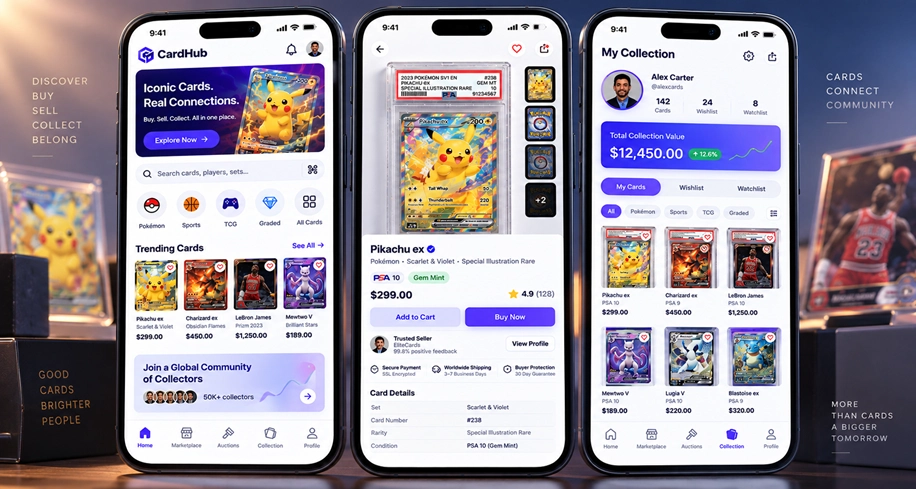
Designing the Foundation of the Marketplace
Designing the Foundation of the Marketplace
Before adding advanced capabilities such as auctions, live breaks, price tracking, or AI recommendations, the marketplace needs a solid technical foundation. The way card information is organized and retrieved will influence almost every other part of the platform.
Build a Flexible Card Data Structure
Trading cards are different from ordinary ecommerce products. Their identity and value can depend on several attributes, including the player or character, set, year, manufacturer, rarity, edition, variant, condition, and grading details.
For example, a baseball card may require information about the player, team, season, and manufacturer, while a Pokémon card may need details about the set, language, rarity, and card variant.
The platform should therefore use a flexible data model that can accommodate different card categories without forcing every card into the same structure. This makes it easier to expand the catalog and introduce new types of collectibles as the marketplace grows.
A well organized card database also provides the foundation for other features, including collection management, price tracking, recommendations, authentication workflows, and analytics.
Make Search a Core Experience
Collectors often search for very specific cards rather than browsing randomly. Someone may be looking for a particular card from a specific set, a PSA 10 graded card, or a card featuring a particular player below a certain price.
For this reason, search should combine keyword matching with structured filters. Users should be able to narrow results by card type, player or character, set, year, rarity, condition, grading, price, edition, and other relevant attributes.
As the volume of card data increases, the marketplace can use dedicated search technology to deliver faster results and handle complex filtering and sorting.
The goal is simple: help collectors find the right card with as little friction as possible.
A strong search experience can improve discovery, engagement, and the overall buying experience while giving the marketplace a scalable foundation for future growth.
Building Trust into the Buying Experience
Trust is a critical part of any trading card marketplace, especially when users are purchasing high value collectibles. Buyers need confidence that the seller is genuine, the card is accurately represented, the payment is secure, and the item will arrive as expected. A marketplace can build this confidence through several connected safeguards.
Seller Verification
Verify sellers and provide profile information to help buyers understand who they are dealing with.
Ratings and Reviews
Let buyers share feedback about transactions, helping establish seller reputation and accountability.
Card Verification
Provide accurate condition, grading, certification, and other relevant card information to support informed purchases.
Authentication
Introduce authentication workflows for high value cards to help identify counterfeit or altered collectibles.
Secure Payments
Use reliable payment processing and appropriate transaction controls to protect buyers and sellers.
Dispute Management
Provide clear processes for handling payment disputes, refunds, chargebacks, and transaction issues.
Protected Fulfillment
Support shipment tracking, insurance, signature confirmation, or specialized fulfillment for higher value purchases.
Transparent Policies
Clearly explain marketplace rules, returns, seller responsibilities, buyer protection, and other transaction terms.
For US based marketplaces, payment processing, seller payouts, refunds, chargebacks, and sales tax requirements should also be considered during product planning. The exact requirements depend on the business model and jurisdictions involved.
These safeguards should be considered part of the marketplace architecture from the beginning, rather than features added after launch. A strong trust framework can help the platform handle increasingly valuable transactions while creating a more reliable experience for collectors.
What Advanced Features Can Add to the Platform?
What Advanced Features Can Add to the Platform?
Once the core marketplace experience is established, advanced features can expand the platform beyond buying and selling. These capabilities can increase engagement, support new revenue opportunities, and create a more complete collecting experience.
Auction Engine
Enable sellers to offer rare, vintage, or high value cards through competitive bidding. The system can manage bid increments, reserve prices, countdowns, winner selection, notifications, and payment collection.
Live Card Breaks
Let collectors purchase spots in live pack or box opening events. This requires integration between streaming, chat, payments, inventory, spot allocation, and transaction records.
Digital Pack Opening
Create an interactive experience where users purchase digital packs and receive randomized cards or collectibles. The backend needs to manage inventory, probability rules, randomization, ownership, and digital collections.
Card Vault
Allow users to store valuable cards through an in house facility or third party vault provider. Users can manage stored cards digitally, monitor their collections, request withdrawals, or potentially sell without physically moving the card.
Price Tracking
Give collectors tools to monitor card prices and changes in market value over time, helping them make more informed buying, selling, and collecting decisions.
Collection Management
Allow users to organize their cards digitally, track ownership, maintain wishlists, and monitor the overall value of their collections.
Trading Features
Enable users to propose and manage card trades, creating another way for collectors to acquire cards without relying solely on direct purchases.
Advanced features should be introduced based on the marketplace’s target audience and operational capabilities. Features such as vaulting, randomized digital packs, and high value auctions can require additional infrastructure, compliance considerations, and operational processes, so they should be planned as part of the broader product strategy.
How Does a Trading Card Marketplace Make Money?
How Does a Trading Card Marketplace Make Money?
A trading card marketplace can generate revenue through several different models. The right approach depends on the platform’s audience, transaction volume, seller base, and the services it provides.
Transaction Commissions
The marketplace can charge a percentage of each completed transaction. This is one of the most common marketplace monetization models.
Seller Fees
Professional sellers may pay listing fees, subscription fees, or other seller-service charges in exchange for access to marketplace tools.
Auction Fees
An auction-based platform can generate revenue through seller commissions, buyer fees, listing fees, or premium auction services.
Featured Listings and Promotions
Sellers can pay to promote specific cards, increase listing visibility, or appear in featured sections.
Premium Seller Plans
Professional dealers may benefit from subscription plans offering advanced inventory management, analytics, bulk listing, promotional tools, or reduced transaction fees.
Authentication and Vault Services
If the marketplace provides authentication, storage, or vault-related services, these can create additional revenue streams through service charges or recurring fees.
Premium Collector Tools
Advanced collection analytics, price tracking, portfolio insights, and other collector-focused features can potentially be offered through premium subscriptions.
The monetization strategy should be considered before development because it can influence payment architecture, transaction accounting, seller payouts, subscription management, and reporting requirements.
Where AI Fits Into Trading Card Marketplace Development
Artificial intelligence can make several parts of the collecting experience faster.
One of the most practical applications is card recognition. Instead of manually entering every card attribute, a seller could upload an image and allow a computer vision system to identify the card and prepopulate relevant information. AI can also support pricing insights by analyzing historical transactions and other market signals.
For collectors, recommendation systems can identify cards that may be relevant based on their browsing history, collection, purchases, or interests. AI can also help sellers generate listing information from images or descriptions. The key is to use AI where it removes friction.
Adding AI simply for the sake of having an AI feature does not necessarily create a better marketplace.
Does a Trading Card Marketplace Need Blockchain?
This is an important question for businesses exploring the Web3 side of collectibles.
The short answer is: not always.
If the marketplace primarily sells physical trading cards, conventional databases, payment systems, and inventory infrastructure may be enough.
Blockchain becomes more relevant when the platform involves digital ownership. For example, a marketplace could use blockchain to create verifiable digital collectibles, represent ownership through tokens, enable digital asset transfers, or maintain an on-chain record of transactions. A hybrid model could also connect physical and digital collectibles, depending on the business model.
However, blockchain introduces additional considerations around wallets, smart contracts, transaction fees, network selection, asset custody, security, and regulatory requirements. It should therefore be introduced because it provides a genuine business or product benefit, not simply because it is available.
For a Web3-focused development partner such as KIR Chain Labs, this distinction is especially important: the blockchain layer should be selected according to the marketplace’s actual ownership and transaction requirements.
Choosing the Right Technology Architecture
A marketplace expected to handle thousands of cards can be built differently from one expected to handle millions of listings, real-time auctions, live streaming, AI processing, and blockchain transactions.
A typical architecture may combine a modern web frontend, mobile application, scalable backend, relational database, dedicated search infrastructure, cloud services, payment integrations, and optional AI or blockchain components.
- Technologies such as React or Next.js can be used for the web experience, while React Native or native mobile development can support iOS and Android applications.
- PostgreSQL can provide a reliable foundation for transactional data, while a dedicated search engine can handle large-scale card discovery and filtering.
For live features, third-party streaming infrastructure can reduce development complexity.
If blockchain is part of the product, the architecture should also account for smart contracts, wallets, blockchain APIs, asset metadata, and transaction monitoring.
The important point is that there should not be a one-size-fits-all technology stack. The architecture should be designed around the marketplace’s expected users, transaction volume, feature roadmap, and business model.
Choosing the Right Technology Architecture
How to Approach Trading Card Marketplace App Development
The most effective marketplace projects usually begin with a focused product rather than attempting to build an entire collectibles ecosystem immediately.
Start by defining the audience.
Are you building for sports card collectors? TCG players? Professional dealers? High-value collectors? Digital asset owners?
Then determine what problem the platform will solve better than existing alternatives. From there, the first version can focus on the fundamental marketplace experience: users, listings, catalog, search, payments, orders, seller tools, and administration.
Once the platform begins generating real usage data, advanced functionality can be introduced based on what users actually need.
- For one marketplace, auctions may be the logical next step.
- For another, professional seller tools may have greater value.
A TCG-focused platform may benefit more from collection management and trading features, while a digital collectibles platform may prioritize blockchain ownership. This approach reduces unnecessary development while creating a clearer path toward product-market fit.
Building a Marketplace That Can Scale
Building a Marketplace That Can Scale
Scalability should be considered before the marketplace becomes large. A platform may begin with a few hundred sellers and thousands of cards, but successful marketplaces can eventually handle much larger inventories and transaction volumes. That growth can affect almost every technical layer.
Search needs to remain responsive.
Images need efficient storage and delivery.
Payment processing needs to remain reliable.
Notifications need to scale.
Auction systems need to handle concurrent bids.
AI processing may require additional computing resources.
Blockchain transactions may introduce external network dependencies.
A modular architecture makes it easier to scale individual components without rebuilding the entire application. This is particularly important when the roadmap includes advanced features that may be introduced months or years after the initial launch.
Common Mistakes Businesses Make
One of the most common mistakes is trying to replicate every feature offered by major platforms.
A new business does not necessarily need auctions, live breaks, digital packs, AI, blockchain, social networking, and vaulting on the first day.
Another mistake is underestimating card data. If the catalog is poorly structured, search and filtering quickly become frustrating.
Trust is another area that is often overlooked. A marketplace dealing with valuable collectibles needs clear policies around sellers, grading, authentication, disputes, payments, and fulfillment.
Finally, businesses sometimes choose technology before defining the product. The better approach is to determine the business model and user experience first and then choose the architecture that supports them.
How KIR Chain Labs Approaches Trading Card Marketplace Development
Building a trading card marketplace requires a combination of marketplace engineering and, for certain business models, Web3 expertise.
KIR Chain Labs can support businesses that want to explore conventional card marketplaces as well as platforms where blockchain, digital collectibles, tokenization, or smart contracts form part of the product strategy. The development process can begin with understanding the marketplace concept, target audience, card categories, monetization model, and required user journeys.
From there, the product can be structured into an MVP and a longer-term roadmap. This helps separate the functionality needed to validate the marketplace from advanced capabilities that can be introduced once there is real user demand.
For a business considering a sports card marketplace, TCG marketplace, digital collectibles platform, auction marketplace, or hybrid Web3 collectibles ecosystem, the architecture can be planned around the specific model rather than forcing the business into a predefined product.
Final Thoughts
Final Thoughts
A trading card marketplace app can be much more than a digital catalog.
At its foundation, it connects buyers and sellers. But with the right product strategy, it can evolve into a complete ecosystem where collectors discover cards, compare prices, participate in auctions, manage collections, join live breaks, store valuable assets, and interact with digital collectibles.
The technology required depends on how far the business wants to take that experience. A focused marketplace may only need a strong catalog, search, payments, seller tools, and collection management. A more ambitious platform may eventually combine AI, live commerce, digital packs, physical vaulting, and blockchain-based ownership.
The most important decision is not how many features the platform can launch with. It is which collector problem the marketplace is going to solve better than the alternatives. Once that is clear, the technology, features, monetization strategy, and development roadmap become much easier to define.
If you have an idea for a trading card marketplace and are evaluating the right technology, feature scope, or blockchain architecture, KIR Chain Labs can help turn the concept into a practical development roadmap.
Have a trading card marketplace idea in mind?
Start with a discussion about your concept, target audience, and required features before committing to development.
Frequently Asked Questions
What is trading card marketplace app development?
Trading card marketplace app development is the process of building a platform where users can buy, sell, trade, auction, and manage sports cards, TCG cards, and digital collectibles.
How much does it cost to develop a trading card marketplace app?
The cost depends on the features, platforms, integrations, and overall complexity. Auctions, live card breaks, digital packs, AI, and card vaults can increase development costs.
How long does it take to build a trading card marketplace app?
The development timeline depends on the project scope. A basic marketplace can be developed faster than a feature rich platform with auctions, livestreaming, digital collectibles, and advanced technologies.
What features should a trading card marketplace app have?
Core features include user profiles, card listings, search and filters, payments, seller dashboards, order management, wishlists, notifications, reviews, and collection management.
Can I build a sports card and TCG marketplace?
Yes. A marketplace can support sports cards and TCG products with categories for players, teams, games, sets, rarity, condition, editions, and grading.
Can a trading card app support auctions and live card breaks?
Yes. Auction functionality can include bidding, timers, bid history, and notifications. Live card breaks can support livestreaming, spot purchases, real time chat, and break management.
Can AI be integrated into a trading card marketplace?
Yes. AI can support card recognition, personalized recommendations, intelligent search, price analysis, fraud detection, and collection insights.
Can a trading card marketplace include a card vault?
Yes. A card vault can help collectors organize and track cards, ownership, grading, storage, purchase history, and estimated collection value.