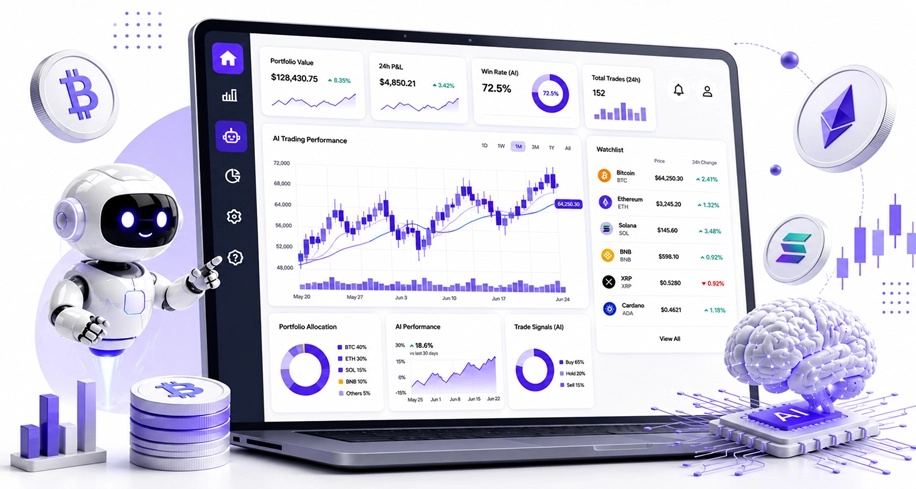
Artificial intelligence has fundamentally transformed how cryptocurrency markets are traded. What began as simple rule-based automation has evolved into sophisticated AI-powered systems capable of analyzing market trends, monitoring sentiment, evaluating on-chain data, and executing trades within milliseconds. In 2026, traders will have access to hundreds of AI crypto trading platforms, each claiming to deliver better returns, smarter decision-making, and fully automated profits.
The challenge is no longer finding a trading bot — the challenge is finding the right one.
Many traders lose money not because the crypto market is inherently unpredictable, but because they choose the wrong platform, ignore risk management principles, trust unrealistic marketing claims, or deploy bots without a proven strategy. This comprehensive guide explains everything you need to evaluate, test, and confidently choose an AI crypto trading bot in 2026.
| Key Insight: The most successful automated traders are not those with the most advanced AI — they are the ones who combine sound strategy, disciplined risk management, and intelligent automation. |
Why AI Crypto Trading Bots Are Rapidly Growing in 2026
The cryptocurrency market never sleeps. Bitcoin, Ethereum, and thousands of other digital assets trade 24 hours a day, seven days a week, across every time zone simultaneously. Human traders simply cannot monitor markets continuously — fatigue, emotions, and cognitive biases create blind spots that bots do not have.
AI trading bots solve this problem by automating both market analysis and trade execution. They can process vast quantities of data in real time, identify opportunities faster than any human, and operate without emotional interference. The key advantages that have driven their rapid adoption include:
- Continuous 24/7 market monitoring across multiple crypto exchanges
- Faster execution speeds — often measured in milliseconds
- Elimination of emotional decision-making and panic selling
- Consistent application of pre-defined risk management rules
- Multi-exchange support for greater flexibility and opportunity
- Automated portfolio rebalancing based on market conditions
However, these advantages only materialize when the bot is built on a sound strategy and deployed correctly. An AI bot running a flawed strategy will simply execute that flawed strategy faster and more consistently — amplifying losses rather than profits.
What Is an AI Crypto Trading Bot?
What Is an AI Crypto Trading Bot?
An AI crypto trading bot is software that uses automation and artificial intelligence to analyze market conditions and execute trades autonomously. Unlike traditional rule-based bots that follow fixed, pre-programmed instructions, AI-powered systems can adapt to changing market conditions by evaluating multiple data sources simultaneously and adjusting their behavior accordingly.
Modern bots typically analyze a wide range of inputs, including:
- Historical and real-time price data across timeframes
- Technical indicators such as RSI, MACD, Bollinger Bands, and moving averages
- Trading volume and order book depth
- Market sentiment derived from social media and news
- Macroeconomic events and announcements
- On-chain analytics including wallet flows and whale activity
- Liquidity conditions on centralized and decentralized exchanges
The goal of an AI trading bot is not to predict the future with perfect accuracy — no system can do that. The goal is to improve the consistency, speed, and discipline of decision-making, while removing the emotional biases that cause human traders to make costly mistakes.
Types of AI Crypto Trading Bots Explained
Types of AI Crypto Trading Bots Explained
Before selecting a platform, it is essential to understand the different categories of bots available in 2026 and what market conditions each is best suited to.
Grid Trading Bots
Grid trading bots are ideal for sideways or range-bound markets where prices fluctuate within a defined range. These bots automatically place multiple buy and sell orders at predetermined intervals, allowing traders to profit from small market movements without constantly monitoring charts. They are particularly effective during periods of low volatility when strong market trends are absent.
Crypto Arbitrage Bots
Crypto arbitrage bots capitalize on price differences for the same cryptocurrency across multiple exchanges. For example, if Bitcoin is trading at a lower price on one exchange and a higher price on another, the bot can automatically buy and sell to capture the spread. These bots require ultra-fast execution speeds, low transaction costs, and access to multiple trading platforms.
Triangular Arbitrage Bots
Triangular arbitrage bots exploit pricing inefficiencies between three different trading pairs on the same exchange. For instance, the bot may trade BTC to ETH, ETH to USDT, and then USDT back to BTC to generate a profit from market discrepancies. These bots are highly sophisticated and are commonly used by advanced traders seeking low-risk opportunities in highly liquid markets.
DCA (Dollar-Cost Averaging) Bots
DCA trading bots automatically purchase cryptocurrencies at regular intervals regardless of market price. This strategy reduces the impact of short-term volatility and helps investors build positions over time. DCA bots are especially popular among long-term investors who want to accumulate assets like Bitcoin and Ethereum without worrying about market timing.
AI Signal Bots
AI signal bots leverage machine learning, predictive analytics, and market sentiment analysis to generate trading opportunities. Instead of relying solely on technical indicators, these bots analyze multiple data sources, including historical price patterns, news events, social sentiment, and on-chain metrics. They are becoming increasingly popular as AI technology advances.
Flash Loan Trading Bots
Flash loan trading bots operate within decentralized finance (DeFi) ecosystems and utilize uncollateralized loans that are borrowed and repaid within a single blockchain transaction. These bots are primarily used for arbitrage, collateral swapping, refinancing, and liquidity optimization strategies. Due to their complexity, flash loan bots are typically used by experienced DeFi traders and institutions.
DeFi Trading Bots
DeFi trading bots automate trading activities on decentralized exchanges (DEXs) and blockchain protocols. They can execute token swaps, liquidity management, yield farming, staking, and cross-chain trading strategies. These bots are particularly valuable for traders seeking opportunities outside traditional centralized exchanges.
Market-Making Bots
Market-making bots continuously place buy and sell orders near the current market price to provide liquidity and profit from the bid-ask spread. These bots are widely used by exchanges, liquidity providers, and professional traders looking to generate consistent returns in highly liquid markets.
TWAD Trading Bots
Time-Weighted Average Deviation(TWAD) trading bots are designed to execute large orders gradually over a specific period. Instead of placing a massive trade that could impact market prices, TWAD bots split the order into smaller transactions and execute them at regular intervals. This strategy helps reduce slippage and is commonly used by institutional traders and high-volume investors.
Choosing the wrong bot type for prevailing market conditions is one of the most common mistakes traders make. A grid bot deployed in a strongly trending market, for example, can experience significant losses as the price moves outside its configured range.
How to Identify a Reliable AI Trading Bot
How to Identify a Reliable AI Trading Bot
1. Security Must Be Your First Priority
Security is the single most important factor when evaluating any trading bot platform. A trading bot requires API access to your exchange account, which means a poorly secured platform could expose your funds to theft or unauthorized trading.
Look for platforms that provide all of the following security features:
- Encrypted API key storage with no ability to withdraw funds
- Two-factor authentication (2FA) on all account actions
- IP whitelisting to restrict API access to authorized addresses
- Comprehensive activity and audit logs
- Granular withdrawal restrictions on API permissions
Never use a platform that requires custody of your funds or asks you to transfer assets into their wallet. Reputable bots connect to exchanges using read-only or trade-only API permissions that cannot initiate withdrawals.
2. Evaluate the Quality of Backtesting
Most platforms advertise impressive historical returns, but the quality of their backtesting methodology varies enormously. A poorly constructed backtest can show spectacular results that would never materialize in live trading.
A trustworthy backtesting system should include all of the following:
- Multiple years of historical data covering varied market conditions
- Testing across both bull markets and bear markets
- Realistic fee calculations that reflect actual transaction costs
- Slippage simulation to account for real-world execution differences
- Walk-forward validation to avoid overfitting to historical data
Always treat backtests as research tools and stress-test scenarios rather than guarantees of future performance. A strategy that performs well in hindsight has not been proven in live market conditions.
3. Analyze Risk Management Capabilities
The best entry signals in the world are worthless without disciplined risk management. Capital preservation is the foundation of long-term trading success, and a bot’s risk management features are often more important than its signal quality.
Essential risk management features to look for include:
- Configurable stop-loss mechanisms at both the trade and portfolio levels
- Position sizing controls to limit exposure per trade
- Daily loss limits that pause trading if a threshold is breached
- Maximum drawdown protection to prevent catastrophic losses
- Emergency kill switches to halt all trading immediately
4. Demand Strategy Transparency
Transparency is a fundamental indicator of platform trustworthiness. You should be able to understand, at least at a high level, how the bot generates decisions, which indicators it weighs most heavily, and how performance metrics are calculated and reported.
Be very cautious of platforms that rely entirely on vague claims such as “proprietary AI algorithms” or “secret signals” without providing any meaningful explanation of their approach. Legitimate platforms are confident enough in their methodology to explain it clearly.
5. Exchange Compatibility and Liquidity
The quality and flexibility of a trading bot are partly determined by the exchanges it supports. Broader exchange support gives you more flexibility in strategy deployment and access to more liquid markets.
In 2026, top-tier platforms typically integrate with leading centralized exchanges, including Binance, Bybit, OKX, Kraken, and Coinbase, as well as major decentralized exchanges such as Uniswap and dYdX. If a platform only supports a small number of exchanges, this may limit your strategy options.
Common Mistakes Traders Make When Choosing a Bot
Trusting Marketing Claims Without Verification
Many platforms advertise extraordinary returns — sometimes claiming monthly returns of 20%, 30%, or more. Responsible traders understand that no strategy wins consistently without periods of drawdown, and that past performance in marketing materials is frequently cherry-picked or based on unreliable backtests.
Before trusting any performance claim, always verify:
- Live performance data with timestamps and trade history
- Historical drawdowns and worst-case loss periods
- Risk-adjusted returns such as the Sharpe ratio or Sortino ratio
- Independent third-party reviews and community feedback
Underestimating the Impact of Trading Fees
Trading fees, spreads, and slippage can significantly erode profitability, especially for strategies that rely on high trade frequency. A strategy generating a 0.3% gain per trade may become unprofitable once exchange fees, gas costs, and slippage are accounted for.
Always calculate net returns after all transaction costs before evaluating a strategy’s viability.
Using Excessive Leverage
Leverage magnifies both gains and losses proportionally. Many new traders focus almost exclusively on the profit potential of leveraged positions while severely underestimating downside risk. A 10x leveraged position can be liquidated by a 10% adverse move.
Starting with no leverage or minimal leverage is the safest approach, particularly when testing a new strategy or platform in live conditions.
Adopting a Set-and-Forget Mentality
AI bots are powerful tools, not autonomous profit machines that require no oversight. Market conditions change, strategies degrade in performance as market dynamics evolve, and exchange environments shift. Successful automated traders regularly review performance data, recalibrate strategies, and make informed adjustments when signals indicate deteriorating performance.
How to Test a Trading Bot Before Going Live
How to Test a Trading Bot Before Going Live
A disciplined testing process is the most reliable way to validate a bot before committing significant capital. Follow this four-step framework:
Step 1: Define Your Strategy Clearly
Before selecting any platform, define your trading strategy parameters with precision. This includes entry conditions, exit rules, position sizing methodology, maximum risk tolerance per trade, and the maximum portfolio drawdown at which you would halt the bot.
Step 2: Use Paper Trading to Validate Logic
Paper trading allows you to run the strategy in real market conditions without risking actual capital. Monitor win rate, execution quality, risk exposure, and strategy consistency across different market phases. Only move forward if results are acceptable across a statistically meaningful sample of trades.
Step 3: Start with Minimal Capital
Once paper trading results are satisfactory, deploy a small amount of real capital — typically no more than you are comfortable losing entirely. The primary objective at this stage is validation in live conditions rather than profit generation. Real execution introduces factors that paper trading cannot fully replicate, including partial fills and latency.
Step 4: Scale Gradually Based on Evidence
Increase capital allocation only after gathering sufficient live trading data over a meaningful time period. This phased approach dramatically reduces the risk of large losses caused by unexpected strategy failures or platform issues that were not apparent during testing.
Emerging AI Trading Trends Shaping 2026
Emerging AI Trading Trends Shaping 2026
LLM-Powered Trading Systems
Large Language Models (LLMs) are becoming increasingly integrated into modern trading platforms. Rather than relying solely on traditional technical indicators, LLM-powered systems can evaluate news headlines, social media sentiment, regulatory announcements, earnings reports, and broader macroeconomic narratives to build a richer contextual understanding of market conditions.
This broader, more nuanced understanding of market drivers enables these systems to adapt more fluidly to sudden market shifts driven by news events rather than purely price-based signals.
On-Chain Intelligence and Blockchain Analytics
Blockchain data provides a category of market intelligence that is entirely unavailable through traditional price charts. Advanced AI systems in 2026 monitor whale wallet activity, stablecoin inflows and outflows, liquidity movements across DeFi protocols, and smart contract interactions to generate forward-looking signals.
These on-chain signals have proven particularly valuable in identifying major market moves before they appear in traditional price data, offering traders an informational edge that was unavailable in previous market cycles.
Multi-Asset Automation
An increasing number of platforms now support automated trading across cryptocurrencies, equities, ETFs, commodities, and foreign exchange within a unified environment. This multi-asset capability enables traders to construct diversified, algorithmically managed portfolios that can reduce concentration risk while maintaining systematic execution discipline.
Mobile-First Trading Interfaces
Professional traders in 2026 expect a full-featured mobile experience as a baseline requirement, not an optional add-on. This includes real-time push notifications for significant market events, remote risk management controls, live portfolio monitoring, and mobile-accessible emergency kill switches to halt trading instantly from anywhere in the world.
Should You Build or Buy a Trading Bot?
Should You Build or Buy a Trading Bot?
For the majority of individual traders, off-the-shelf platforms provide the most practical path to automation. They offer quick deployment, lower upfront cost, community support, and ongoing updates from development teams with dedicated trading expertise.
However, custom development becomes a compelling option in several specific scenarios:
- Your strategy involves proprietary logic that you are not willing to share with a third-party platform
- You require unique exchange integrations or data source connections not available on standard platforms
- You are building a commercial trading product for institutional or enterprise clients
- Your arbitrage strategy requires highly customized latency optimization and infrastructure
Custom development delivers greater control and flexibility, but requires a substantially larger initial investment, ongoing technical maintenance, and deep expertise across trading logic, exchange APIs, cloud infrastructure, and security architecture.
Ready to Build Your Own AI Crypto Trading Bot?
Launch advanced AI trading solutions with arbitrage strategies, flash loan automation, market-making engines, DeFi integrations, and real-time analytics tailored to your business goals.
How to Choose an AI Crypto Bot Development
How to Choose an AI Crypto Bot Development Company
If custom development is the right path for your use case, selecting the right crypto trading bot development partner is critical. A technically capable but strategically inexperienced team can build a technically sound product that fails in live trading conditions.
Evaluate prospective development partners across these six dimensions:
- Technical depth in AI/ML and algorithmic trading systems
- Demonstrated blockchain and exchange API integration experience
- Robust security practices including penetration testing and code audits
- A verified portfolio of live trading products, not just demos
- Transparent development process with clear milestones and communication
- Committed post-launch support including performance monitoring and updates
A reliable development partner understands not just how to write code, but how trading logic, exchange infrastructure, and market microstructure interact to determine real-world performance.
The Future of AI in Crypto Trading
The Future of AI in Crypto Trading
AI adoption in financial markets will continue accelerating over the coming years. The integration of more powerful foundation models, richer data sources, and lower-latency infrastructure is progressively closing the gap between institutional-grade and retail-accessible trading capabilities.
Innovations anticipated to reshape the landscape in the near term include:
- Fully autonomous portfolio managers capable of dynamic strategy selection
- Real-time multi-modal sentiment engines combining text, audio, and video signals
- Advanced predictive analytics incorporating macroeconomic and geopolitical factors
- Multi-chain intelligence systems that operate seamlessly across blockchain ecosystems
- Adaptive risk management models that self-calibrate based on regime detection
Despite these technological advances, the fundamental principles of sustainable trading will remain unchanged: sound strategy, disciplined risk management, and realistic expectations will always determine long-term outcomes more than any single technological advantage.
Conclusion
AI crypto trading bots are powerful tools that can help traders improve execution efficiency, reduce the influence of emotional decision-making, and systematically manage opportunities across multiple markets and asset classes. However, choosing the right platform demands careful, evidence-based evaluation rather than a response to marketing headlines.
Focus your evaluation on security architecture, strategy transparency, risk management capabilities, crypto exchange compatibility, and demonstrated long-term reliability. Invest time in testing strategies before committing significant capital, start small, and commit to continuous performance monitoring.
The traders achieving sustainable results in 2026 are not necessarily those deploying the most sophisticated AI. They are the traders who combine disciplined strategy, intelligent automation, and a rigorous approach to risk to build results that compound consistently over time.
Frequently Asked Questions
Frequently Asked Questions
Do AI crypto trading bots actually work?
Yes — when combined with a well-researched strategy and disciplined risk management, AI trading bots can meaningfully improve execution consistency and efficiency. However, no bot can guarantee profits, and performance is directly tied to the quality of the underlying strategy and the market conditions it is deployed in.
How much money do I need to start with a trading bot?
Many platforms support starting balances as low as a few hundred dollars. However, the most important principle is to only deploy capital you are fully prepared to lose. Begin with a minimal amount during the validation phase and scale only after live performance data justifies it.
Are AI trading bots safe to use?
Safety depends on the specific platform’s security architecture, API permission management, fund custody model, and risk controls. Use only platforms that do not custody your funds, support withdrawal-restricted API keys, and provide comprehensive activity monitoring.
Can complete beginners use AI trading bots?
Yes. Many platforms in 2026 offer beginner-friendly interfaces, guided strategy setup, and paper trading environments for risk-free learning. That said, all traders should develop a basic understanding of risk management principles before deploying real capital.
Can AI accurately predict cryptocurrency prices?
No AI system can reliably predict future prices with certainty. AI can identify statistical patterns, evaluate probabilities, and improve decision-making consistency — but cryptocurrency markets involve genuine uncertainty that no model can eliminate.
Is building a custom trading bot worth the investment?
Custom development is worth considering when you require proprietary strategy protection, unique integrations unavailable on standard platforms, or are building a commercial trading product. For most individual traders, a well-chosen off-the-shelf platform offers the best balance of capability, cost, and speed to deployment.